Belém or Alfama? What a Lisbon Tuk-Tuk Tour Actually Covers
Most Lisbon tuk-tuk tours cover Alfama, not Belém — only 5 of 21 reach Jerónimos or Belém Tower. How to read a listing before you book, and which trip you want.
If you take one thing from this page, take this: Alfama and Belém are two different trips, and most Lisbon tuk-tuk tours only do the first one. They sit about 6 km apart at opposite ends of the city, and booking an “Alfama and viewpoints” tour while picturing the Jerónimos Monastery is the single most common way people end up disappointed with an otherwise excellent tour.
I went through all 25 tuk-tuk listings in the Lisbon pool this site tracks and read their stop-by-stop itineraries rather than their marketing copy. The gap is bigger than I expected, and it’s the reason this page exists.
The numbers, from the listings themselves
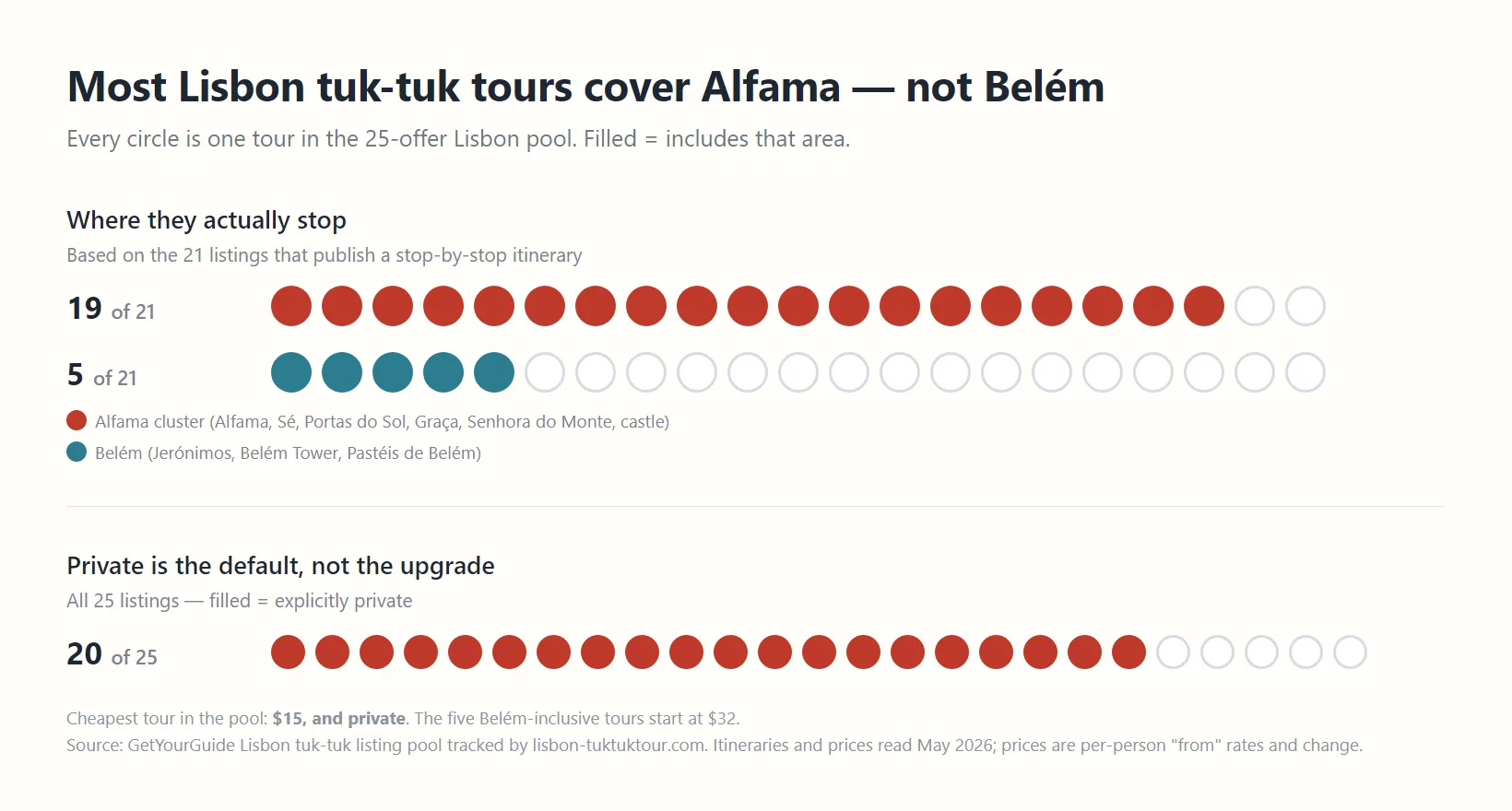
Of the 25 offers, 21 publish a structured itinerary — an actual named list of stops. Among those 21:
- 19 include the Alfama cluster — Alfama itself, the Sé Cathedral, Portas do Sol, Santa Luzia, Graça, Senhora do Monte, or the castle perimeter.
- 5 include anything in Belém — Jerónimos, Belém Tower, or Pastéis de Belém.
Alfama is effectively the default Lisbon tuk-tuk tour. Belém is the exception, and it clusters at the pricier end.
The five that genuinely reach Belém, cheapest first: $32, $39, $42, $87 and $89. Two of them are Belém-specific tours rather than city tours that happen to swing west. Compare that to the Alfama-side options, which start at $15. If Belém is on your list, you are shopping in a different — and generally more expensive — bracket. (Prices are the “from” rates shown on the listings when checked in May 2026, per person, and they move with season and group size — always confirm on the booking page.)
Why the listings mislead — check the itinerary, not the gallery
Here’s the mechanism, and it’s worth understanding because it will save you the mistake.
Tour listings illustrate themselves with generic Lisbon icons. Our own featured tour is a good example: its photo gallery includes both the Jerónimos Monastery and Belém Tower, but its published itinerary — 20 named stops — contains neither. It is an Alfama, Graça and miradouro tour, and a very good one. The photos are simply Lisbon stock imagery, the same way a Paris listing might show the Eiffel Tower it never stops at.
This isn’t usually deception. It’s just how listing galleries work. But it means:
Read the itinerary tab. If “Jerónimos”, “Belém Tower” or “Pastéis de Belém” are not named as stops, the tour does not go there — no matter what the photos show.
That one habit is the whole trick.

Which trip do you actually want?
Choose Alfama if you want the old city and the views
Alfama, Mouraria and Graça are the medieval hill quarter — the part of Lisbon that survived the 1755 earthquake. They are also genuinely steep. The streets stack up toward the castle in a tangle of stairs, cobbles and gradients that will flatten most people’s afternoon if they try to walk the whole thing in summer heat. That gradient is the entire reason a tuk-tuk market exists here: it is a vehicle small enough for the lanes and powered enough for the climbs.
The payoff is the miradouros — Lisbon’s terraced viewpoints. The ones that recur across these itineraries are Portas do Sol and Santa Luzia (the postcard views over Alfama’s rooftops to the river), Graça, and Senhora do Monte, the highest of the group. Chaining several of them in 90 minutes is something a tuk-tuk does well and your legs do badly.
This is what our featured tour covers, and where the value sits at $34 for a private ride.
Choose Belém if you want the monuments
Belém is a flat riverside district roughly 6 km west of the centre, and its appeal is completely different: the Jerónimos Monastery, Belém Tower, the Padrão dos Descobrimentos, and the original Pastéis de Belém bakery. There are no hills to conquer, which weakens the core argument for a tuk-tuk considerably.
If Belém monuments are your priority, book a Belém tour rather than our featured Alfama one — the two Belém-specific options in the pool exist precisely for this. Honestly, though, you should also know the cheap alternative: Belém is easy to reach on your own. Tram 15E runs there from Praça da Figueira via Praça do Comércio and Cais do Sodré in around 25 minutes, and the Cascais-line train from Cais do Sodré stops at Belém. Since the district is walkable and flat once you arrive, plenty of visitors are better served by a tram ticket and an afternoon than by a tour.

Doing both in one tour
A handful of listings do attempt the full sweep. Be realistic about what that costs you: the two ends of the city are far enough apart that a combined tour spends real time in transit, and at 90 minutes you will get a windscreen tour of both rather than a proper look at either. If you want both, budget three hours or more — or, better, treat them as two separate mornings.
Don’t pay extra chasing “private” — it’s already the default
This surprised me. Of the 25 listings, 20 are explicitly private — your own vehicle, your own guide, no strangers. Private is not the premium tier in the Lisbon tuk-tuk market; it is the standard product.
Which means the usual “shared is cheaper” logic mostly doesn’t apply here:
- The cheapest tour in the entire pool is $15 — and private (rated 4.88 across 472 reviews).
- The most-reviewed listing, with over 5,000 reviews, is private and sits at the top of the price range.
- There is essentially no meaningful budget shared-tuk-tuk tier to trade down into.
So if you see a listing charging a premium for the word “private”, check what the alternatives cost before assuming you’re getting an upgrade. You very likely aren’t.
One honest caveat on our featured tour: its 90-minute option may be shared with another small group if you book for one or two people. Three or more, and the 90-minute is fully private; the 2-hour and 3-hour options are always fully private regardless of group size. That detail is in the operator’s own fine print and it’s worth knowing before you pick a duration.
When a tuk-tuk isn’t the right answer
Being straight about this: a tuk-tuk tour is not always the best purchase.
- If you’re on a tight budget and just want the Alfama scenery, Tram 28 covers similar ground for the price of a transit ticket. It’s cramped, slow and notorious for pickpockets, and you get no commentary — but it’s a fraction of the cost. I’ve laid out the full trade-off in tuk-tuk tour vs Tram 28 rather than re-arguing it here.
- If you’re a confident walker with a free morning and mild weather, Alfama is genuinely rewarding on foot. The tuk-tuk buys you hills and coverage, not access.
- If your list is mostly Belém, see above — take the tram.

Where a tuk-tuk earns its money is a specific case: limited time, several hilltop viewpoints, heat or mobility limits, and a guide worth listening to. That describes a lot of first-time visitors, but not all of them.
A note on Lisbon’s tuk-tuk street rules
You may have read that Lisbon has restricted tuk-tuks. This is real but frequently overstated online, so here is what I can confirm and what I can’t.
Lisbon City Council brought in a regulation for tourist vehicles that took effect on 1 April 2025, banning circulation on a defined list of 337 streets — including streets in the central parishes that contain Alfama and Graça — alongside 09:00–19:00 operating hours and a ban on combustion-engine tuk-tuks from the end of 2026. An industry association filed a legal challenge against parts of the regime in May 2025.
What I could not verify from a primary source is the current status of that challenge, or the precise street list as it stands today, so I’m not going to tell you exactly which lanes your driver can and can’t enter. What the operating listings show is that tours are running normally and still routing to the main miradouros — and the featured operator’s own booking notes say that where a street is narrow or restricted, they arrange an alternative nearby pickup point. Two practical takeaways: expect the occasional short walk from a drop-off to a doorway, and note that an electric tuk-tuk is the future-proof choice given the combustion phase-out. Our featured tour is electric.
Practical notes worth knowing
- Duration shapes the route. Most listings run flexible windows — the featured tour spans 1.5 to 3.5 hours — and the stop count scales with what you book. The 90-minute version is a highlights loop; three hours is where a tour starts to breathe.
- Under-5s cannot ride. Portuguese regulations prohibit children under five on tuk-tuk tours, and every participant aged 5 and over needs their own ticket. Worth checking before you book for a family.
- Hotel pickup is usually a longer-option perk. On the featured tour it’s available only on the 3-hour booking; shorter options use a fixed meeting point.
- Monument entry is almost never included. These are photo-stop and commentary tours. Entrance fees to the castle, the Fado Museum or Jerónimos are on you.
If you want to see the ground these tours actually cover before committing, the Lisbon tuk-tuk route map plots the standard stops.
And once you’re off the tuk-tuk: Alfama’s hills are best followed by sitting still with something to eat. Morning tours finish right around lunch, which pairs naturally with a Portugal food tour — tastings through the same quarter you’ve just been looking down at from the viewpoints.
The short version
Book an Alfama-and-miradouros tuk-tuk tour if you want the old city, the hills and the views — that’s what nearly every listing here delivers, and what the featured $34 private electric tour does across 20 named stops. Book a dedicated Belém tour, or just ride tram 15E, if the monuments are what you came for. Read the itinerary rather than the gallery, and don’t pay a premium for “private” in a market where private is already the norm.
Book the featured experience
Check live availability and pricing for the featured experience. Free cancellation. From $34 per person.
Check Availability & Book